OPINION
By Elias Wondimu, Senior Fellow, the International Strategic Studies Association.
FOR MUCH OF THE PAST CENTURY, global conflict turned on oil. Empires rose and receded along pipelines. Wars were justified in the language of energy security. Entire regions were reordered to guarantee supply.
Yet as the world moves deeper into the twenty-first century, another resource—older, more limited, and far less negotiable—has begun to redraw the map of power: potable or fresh water. As climate pressure tightens, the consequences are no longer theoretical. They are unfolding in specific places, with specific histories.
Few reveal this change more starkly than Ethiopia.
From the Ethiopian highlands, where seasonal rains gather into streams that form the Blue Nile, a river flows north through Sudan and Egypt, sustaining tens of millions before reaching the Mediterranean. For generations, however, Ethiopia’s position within this system has been deeply paradoxical. It supplied the water but exercised little say over its use. Authority accumulated downstream, shaped first by empire and later by infrastructure that converted flow into command.
That arrangement is now under strain.
At its center stands the Grand Ethiopian Renaissance Dam (GERD), a hydroelectric project conceived in 2011 and completed more than a decade later through domestic financing and mass public participation. Technically, the dam is straightforward: water passes through turbines and continues downstream. Politically, it is anything but. GERD has become a focal point for anxiety over sovereignty, precedent, and who bears the cost of stability in a world shaped increasingly by scarcity.
Empire’s Long Shadow
The Nile’s political architecture did not emerge from hydrology alone. It was built by imperial design.
During the colonial period, treaties governing the river prioritized British strategic interests and elevated Egypt as the principal beneficiary. Upstream territories, including Ethiopia, were treated as sources rather than stakeholders. This imbalance persisted after independence, particularly following the construction of the Aswan High Dam in the 1960s. That project delivered electricity, flood control, and storage capacity on a continental scale, consolidating Egypt’s command over the river’s rhythm.
For decades, this asymmetry provoked little international debate. Development downstream was treated as essential; restraint upstream as prudent. The assumption beneath this arrangement was rarely stated but widely accepted: Ethiopia’s water wealth need not translate into Ethiopian power.
Over time, this asymmetry did more than allocate water; it shaped the region’s political environment. Ethiopia’s security challenges and internal fractures unfolded within a broader strategic landscape in which Nile control and Red Sea access carried existential importance for downstream powers. This did not require constant intervention or direct orchestration. The effect was structural. Ethiopia remained surrounded by incentives that rewarded distraction, division, and inward preoccupation, even as successive domestic elites made choices that deepened these vulnerabilities. Responsibility was never external alone. Yet the river’s politics ensured that Ethiopia’s instability was rarely incidental to regional calculations.
GERD unsettled this long-standing logic. What had been framed as responsible restraint now appeared, to those accustomed to it, as defiance.
Development Recast as Provocation
When Ethiopia began building the dam, it did so to address a domestic crisis. Tens of millions lacked electricity. Industrial growth had stalled. Heavy dependence on rain-fed agriculture left the economy exposed to climate volatility. Hydropower offered a way forward.
As the dam neared completion, however, the discourse shifted. Ethiopia was increasingly portrayed as threatening the Nile, despite the non-consumptive nature of hydropower. The act of generating electricity was recast as an assertion of control. Development itself became suspect.
This reframing reached a critical point in October 2020, when Donald Trump publicly suggested that Egypt might destroy the dam. Though no action followed, the remark altered the diplomatic atmosphere. A dispute previously governed by engineering and law entered the language of force.
The implications were severe. Egypt does not border Ethiopia. Any military action would have required regional overflight, alliance coordination, and acceptance of escalation across the Horn of Africa. That such language could be voiced so casually exposed how thin the boundary between mediation and coercion had become. What was at stake was not only the dam itself, but the principle that development by an upstream state could be treated as a security threat.
Crisis Convergence as Proxy Conflict
Twelve days after President Trump publicly speculated about striking the dam, Ethiopia descended into internal war. On November 4, 2020, the Tigray People’s Liberation Front launched coordinated attacks against federal military installations across the north, triggering a conflict that rapidly drew in regional actors and international attention.
So did the geopolitical environment into which the war erupted.
What followed was not merely a domestic confrontation between a central government and a former ruling elite. It became a proxy arena in which regional and global alignments hardened quietly. Humanitarian language and strategic positioning began moving in parallel, shaping external responses that constrained Ethiopia’s options without openly declaring strategic intent. Narratives that had already portrayed Ethiopia as destabilizing the Nile extended into broader depictions of the state as illegitimate or expendable in the name of regional order.
Ethiopia faced pressure on two fronts. Militarily, attention and resources turned inward. Politically, room for maneuver narrowed as international institutions, advocacy networks, and foreign governments adopted positions that often mirrored their interests in the Nile dispute. Sovereignty, leadership, and development claims were filtered through a single lens—one that rarely distinguished between internal governance failures and external strategic stakes.
The alignment proved uneven. Adversaries gained narrative traction in Western capitals. Humanitarian concern merged with strategic constraint. Financial leverage followed. Development projects, debt relief, and diplomatic engagement were recalibrated in ways that clarified which priorities carried weight and which could be deferred.
Throughout this period, the dam itself remained unchanged. It neither fired a shot nor diverted the river. Concrete held. Turbines turned. Water continued downstream, as it always had.
The Nile did not become a weapon. The conflict surrounding it did. That distinction would matter far beyond Ethiopia, shaping expectations about how shared resources are treated under pressure.
Scarcity Comes Into View
By 2021, the broader context could no longer be ignored. Climate change ceased to be abstract. Droughts intensified across Africa and the Middle East. Rivers narrowed. Aquifers declined. The assumption that freshwater scarcity could be managed without geopolitical consequence began to unravel.
That strategic shift was formally cemented in mid-2022. In June, Vice President Kamala Harris stood at the White House to declare most fundamental national security interests depend on water security, warning it could provoke armed conflict and destabilize nations. This official stance echoed a view she had advanced earlier, she had warned that the next wars would likely be fought over water, not oil.
The declaration reflected a hardening consensus in policy circles around a simple, brutal logic: water has no substitute, is tethered to geography, and resists technical or market fixes, making its scarcity a fundamental catalyst for future strife.
Water is the most visible expression of a broader reality. As climate pressure accelerates, scarcity is becoming the defining condition of global politics. Energy, arable land, and strategic minerals are entering sharper competition. What sets water apart is not that it is uniquely contested, but that it is the least replaceable and the most foundational. It cannot be relocated, reproduced at scale, or withheld without direct human consequence. River disputes are therefore not anomalies but early signals of how power tightens as abundance gives way to constraint.
Seen in this light, Ethiopia’s position no longer appears exceptional. It began to look like a preview..
As the water tower of Africa, Ethiopia occupies a deeply paradoxical place: water-rich yet energy-poor, demographically significant yet economically constrained, historically sovereign yet long excluded from decisions about the river that rises on its soil. GERD seeks to resolve part of this imbalance by converting flowing water into electricity and chronic scarcity into national capacity.
That effort unsettles others—not because the dam removes water, but because it redistributes authority over the river’s future. For decades, decisions about the Nile’s use were anchored downstream. Now, Ethiopia’s bid to harness its own water wealth challenges long-standing precedents.
This intention was stated plainly during the dam’s inauguration in 2025. Prime Minister Abiy Ahmed described GERD as the outcome of “a people who chose contribution over complaint and patience over dependency.” The project, he said, was built not to deny water to others, but to bring light to homes that had known darkness for generations. The Nile would continue its course, he added, but Ethiopia’s future would no longer wait on permission.
Davos and the Shape of Power in the Present
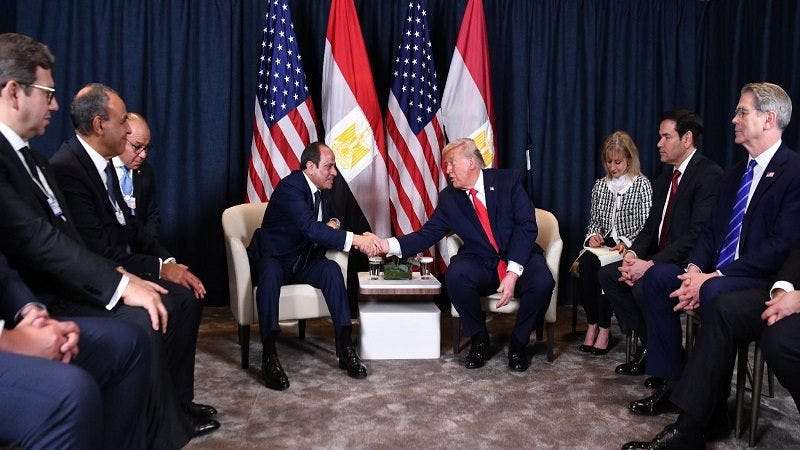
These dynamics resurfaced in January 2026 at The World Economic Forum in Davos. Seated beside Egypt’s president, Abdel Fattah el-Sisi, Donald Trump spoke of reviving negotiations over the Nile, framing renewed U.S. involvement as stabilizing.
The language was familiar and procedural. The river was treated less as a shared ecological system than as a variable to be managed for regional balance. Ethiopia appeared in the conversation, but remained largely outside the frame through which the issue itself was defined.
The Nile was absorbed into a broader calculation that linked Egypt’s regional standing, American mediation, and security priorities stretching from Gaza to the Red Sea. Stability, as presented, would be shaped by those already deemed strategically essential, while those without comparable leverage would be expected to adjust.
Davos, once a forum for global consensus, now carried a sharper edge. Confidence in impartial mechanisms had given way to assumptions that overt power would shape outcomes. The Nile discussion reflected that shift with striking clarity.
A Longer Warning, Repeated
That same week in Davos, Mark Carney, Canada’s prime minister, gave voice to an unease long familiar beyond the Western world. Speaking to global leaders, he argued that the assumptions underpinning the postwar order—predictability, restraint, and enforceable rules—could no longer be taken for granted. Middle and smaller states, he cautioned, now operate in a landscape where dependence creates exposure, and mediation often serves those with leverage.
From a Global South perspective, the force of Carney’s remarks lay less in their insight than in their candor. What he described as a rupture has, for many countries, been a durable condition. Law has always traveled unevenly. Economic pressure, diplomatic coercion, and selective enforcement have long shaped outcomes, while appeals to principle gained traction only when backed by power.
Carney’s notion of “value-based realism” seeks adaptation without surrendering Western managerial authority. Cast as pragmatism, it nonetheless aims to preserve influence within a system already moving toward multipolarity. Sovereignty, in this formulation, becomes conditional—channeled through financial and institutional arrangements forged in an earlier, more hierarchical era.
This helps explain the uneven reception of his message. For Western middle powers, the weakening of American guarantees signals loss and uncertainty. For much of the Global South, the erosion of the old order appears less as collapse than as exposure. What is now spoken of openly—a world governed by leverage rather than law—is one many have navigated for decades.
Read this way, Carney’s warning does not inaugurate a new era. It registers a delayed recognition.
For Ethiopia, that recognition carries a deeper historical echo.
Nearly ninety years earlier, in 1936, Emperor Haile Selassie stood before the League of Nations to deliver a warning of a related kind. He spoke not as a theorist of order, but as its casualty. Ethiopia had followed the rules, appealed to collective security, and trusted international law. It was invaded nonetheless. His appeal reached beyond Ethiopia’s fate. If aggression went unanswered there, he warned, the system itself would stand exposed. Law without enforcement would prove hollow. Peace built on selective principle would not endure.
History confirmed his warning within years.
Read together, Haile Selassie’s appeal and Carney’s diagnosis trace a single arc. The first exposed a world unwilling to defend its commitments. The second describes a world increasingly frank about that reality. In both moments, the weight of order fell on those least able to carry it.
Ethiopia’s struggle over the Nile unfolds within this continuum. Once again, adherence to law and pursuit of development collide with a system that privileges leverage over equity. Once again, restraint is demanded from those whose restraint has long been assumed.
The names have changed. The warning has not.
Precedent and the River’s New Course
The dispute over GERD is not, at its core, a quarrel about water levels or filling schedules. It is a contest over authority in an age where scarcity sharpens every assertion of power. The question it poses is structural: who may convert natural endowment into national capacity when resources cross borders and leverage does not?
If Ethiopia is compelled to surrender control over a domestically financed project on its own territory, the signal will travel well beyond the Nile Basin. It will affirm that development by states without strategic weight remains provisional—and that inherited hierarchies of resource control retain veto power over the future.
If, instead, Ethiopia retains authority within the bounds of law and cooperative practice, a different path comes into view—one in which water does not simply become the next oil, and scarcity does not harden into domination. Such an outcome would not erase conflict, but it would mark a shift from imposed stability to negotiated coexistence.
The Blue Nile continues to flow north, indifferent to diplomacy. What has changed is the meaning assigned to its movement. By turning water into electricity, Ethiopia has turned geography into choice—and in doing so has placed the world before a decision it can no longer defer.
How the world responds will show whether the coming age of water scarcity repeats the patterns of the past — or whether it finds a more equitable way forward.
Elias Wondimu is a Senior Fellow at the International Strategic Studies Association, and a Fellow of the Los Angeles Institute for the Humanities. His work examines Ethiopia’s history, geopolitics, and narrative sovereignty, with particular attention to how African voices shape global politics and cultural understanding. He is the founding director of TSEHAI Publishers, and the editorial director of The International Journal of Ethiopian Studies.