By: Dawit Astatike
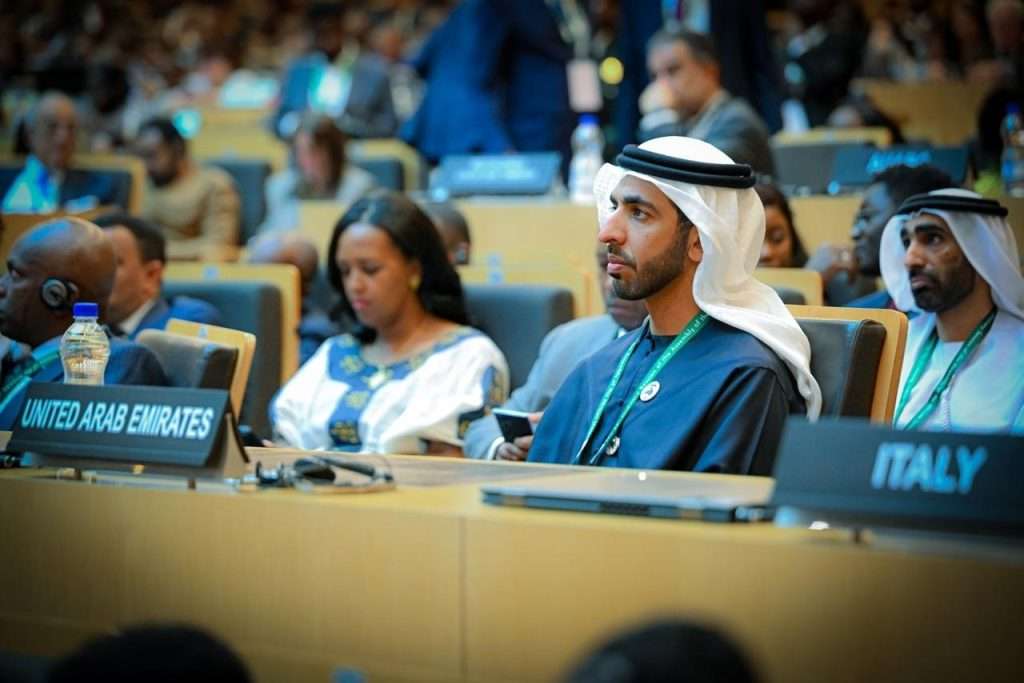
Ethiopia Today (Addis Ababa), February 15, 2026: At the 39th Ordinary Session of the African Union Summit, Sheikh Shakhbout bin Nahyan Al Nahyan, Minister of State, reaffirmed the United Arab Emirates’ role as a premier strategic partner for Africa’s future.
Representing the vision of President Sheikh Mohammed bin Zayed Al Nahyan, the minister highlighted a historic surge in bilateral cooperation, headlined by a staggering $110 billion in UAE investments committed to the continent between 2019 and 2023.
Addressing heads of state and senior officials, Sheikh Shakhbout emphasized that the UAE’s engagement—ranging from landmark clean energy projects to nine Comprehensive Economic Partnership Agreements—is not merely transactional but a deep-rooted commitment to the African Union’s Agenda 2063 and the shared pursuit of peace, stability, and sustainable industrialization.
Sheikh Shakhbout bin Nahyan Al Nahyan, Minister of State, participated in the African Union Summit on February 14, 2026, in Addis Ababa, Ethiopia, with the participation of heads of state and government and senior officials, to discuss the continent’s priorities, including peace and security, economic integration, and sustainable development.
The participation of the United Arab Emirates reflects the wise leadership of Sheikh Mohammed bin Zayed Al Nahyan, President of the State, in consolidating the UAE’s relations with African countries, strengthening partnerships based on trust and mutual respect, and supporting efforts for peace, stability, and sustainable development on the continent.
Speaking at the Summit, Sheikh Shakhbout bin Nahyan Al Nahyan said, “Our engagement with Africa is rooted in decades of trade, maritime links, and people-to-people connections across the Red Sea and Indian Ocean corridors. Today, that historic connectivity is reflected in a growing diplomatic footprint (19 embassies in Sub-Saharan Africa) with further expansion underway. At the same time, African diplomatic representation in the UAE continues to grow, reinforcing our country’s role as a hub for African trade, finance, and dialogue.
The UAE also affirms its support for the goals of the African Union’s Agenda 2063 and its commitment to strengthening cooperation with the African Union Commission and member states in the areas of trade and investment, renewable energy, food security, digital transformation, and capacity building.
On the sidelines of the summit, Sheikh Shakhbout bin Nahyan Al Nahyan met with many African leaders and officials, where they discussed the latest political and economic developments and emphasized the continued strengthening of cooperation with African countries.
Cooperation between the UAE and Africa is driven by several progressive indicators, including trade and investment and humanitarian engagements, among other things.
Between 2019 and 2023, the UAE committed more than USD 110 billion in investments across Africa—the highest level by any single country during that period. More than USD 70 billion of that capital has been directed toward energy, green, and renewable sectors. This reflects a long-term assessment that energy access is the foundation of industrialization and economic diversification.
Under the Africa Green Investment Initiative, USD 4.5 billion has been mobilized to accelerate clean energy development, with more than 60 projects in preparation across solar, wind, geothermal, battery storage, and green hydrogen technologies.
Masdar’s USD 10 billion Africa program and the Etihad 7 initiative aim to help expand access to electricity to up to 100 million people by 2035. These projects are designed to expand generation capacity and reduce structural power deficits.
The UAE has concluded 9 Comprehensive Economic Partnership Agreements with African countries: Nigeria, DRC, Sierra Leone, Gabon, Angola, Kenya, Congo-Brazzaville, Mauritius, and the Central African Republic. These agreements extend beyond tariff reductions to services, digital trade, and investment protection.
They are structured to complement the African Continental Free Trade Area by strengthening value chains and facilitating cross-border competitiveness.
On the logistics side, DP World continues expanding operations across African ports, including a USD 1 billion upgrade of Dar es Salaam Port in Tanzania. AD Ports has broken ground on a new terminal in Luanda, significantly increasing container capacity in Angola. These are long-term trade-enabling assets aligned with regional integration ambitions.
Over the past decade, nearly 40% of the UAE’s total foreign assistance—approximately USD 20.9 billion has been directed to African countries, covering development, humanitarian, and charitable assistance.
Looking forward, water and climate resilience are emerging priorities. The UAE will co-host the 2026 UN Water Conference with Senegal from 2 to 4 December 2026. It will be the first time two Global South countries jointly lead this global process, underscoring a shared commitment to accelerating progress on water security and sanitation—a central development challenge across the continent.