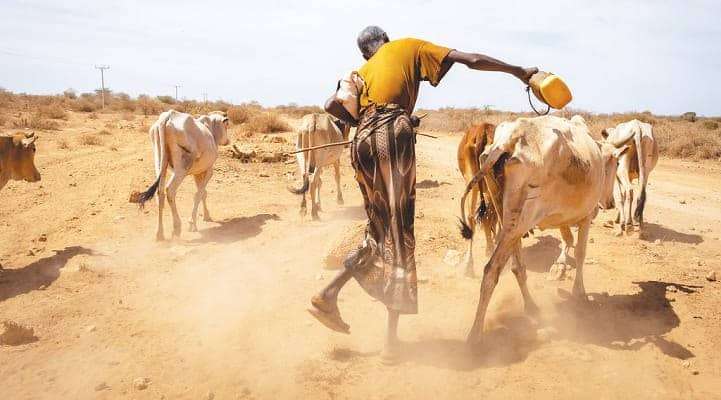
Drought hits the entire part of the region.
Addis Ababa,( Ethiopia Today, March 11, 2023: Some 3.7 million people in Somalia are in dire need of humanitarian aid due to the drought, Somalia’s regional state communication bureau disclosed.
The Head of the Communication Bureau, Abdulqadir Reshid, said that even though the drought has occurred in all zones of the state, Shebele, Dawa, and Afdher have been the worst hit.
According to him, of the 3.7 million citizens exposed to severe problems due to the drought, it is possible at present to address only 1.3 million of them, which means that 2.4 million citizens are in dire need of emergency assistance. He further stated that close to 340,000 cattle, including camels, have died of drought, and about 60,000 are in high jeopardy.
The government, along with a number of charity organizations, has been doing a lot to provide drought-affected citizens with humanitarian aid, animal fodder, and other necessary inputs, especially in hard-hit areas like Afdher, Dawa, and Shebele, he said, adding that it is not sufficient compared to the need. Citing the commencement of coordinated steps to rein in the magnitude of the drought since last January, Abdulqadir said animal fodder has been produced in the state using the funds secured from the World Bank.
“Coordinated undertakings are underway to overcome the challenge, apart from setting up a command post for the purpose of meticulously looking into the magnitude of the drought. However, it is impossible to sufficiently access all zones as the problem is quite vast,” he added. According to Abdulqadir, the people affected are being supported using a safety net run by the World Food Program, but the problem might be exacerbated since all people in the zone have been recipients of the safety net.
He finally urged the government to continue supporting the state and requested international aid organizations, all Ethiopians, and foreigners of Ethiopian origin to exert combined efforts since the issue could not be left only to the federal government and the state itself.
Credit: EPA