
By: Our Staff Reporter
Ethiopia Today (Addis Ababa), May 30, 2026: On the sun-drenched outskirts of Modjo, a critical transformation is quietly reshaping the backbone of East Africa’s largest economy.
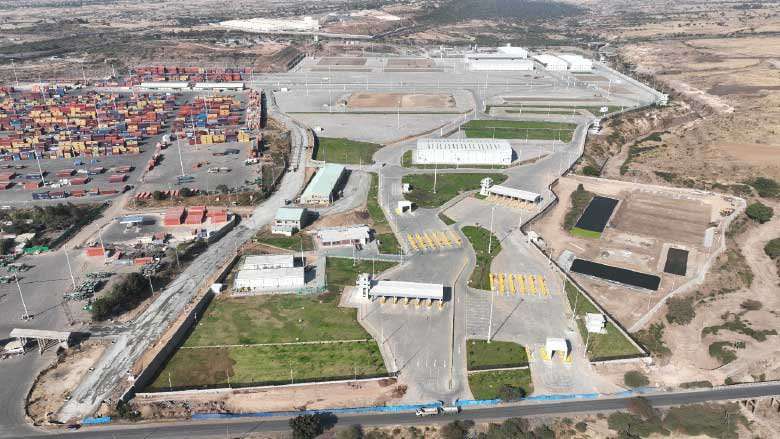
Rows of multi-colored shipping containers that once sat stranded for months are now stacked in orderly, fast-moving lanes. Newly paved arterial roads, sprawling modern warehouses, and dedicated truck terminals underscore a visible reality: Ethiopia’s primary trade artery is finally finding its flow.
For over a decade, the Modjo Dry Port has operated as the exhausting bottleneck of Ethiopia’s economy, serving as the inland destination for roughly 90% of all transit cargo arriving from the Port of Djibouti. But systemic congestion, fragmented paperwork, and rigid state monopolies frequently brought trade to a standstill, leaving businesses to swallow the astronomical costs of delay.
Now, backed by strategic funding from the World Bank, a massive infrastructure and policy overhaul is turning this notorious logistical choke point into a fluid multi-user hub.
The Cost of a Missing Document
In landlocked Ethiopia, where the 1,000-kilometer Djibouti corridor functions as an economic lifeline, any disruption ripples instantly to the consumer.
“Efficient logistics is entirely about predictive planning and synchronized coordination—getting goods to move at the precise window required and at the lowest possible cost,” says Elizabeth Getahun, General Director of Panafric, a leading freight forwarding company based in Addis Ababa.
When that synchronization breaks down, the financial penalties accumulate fast. A single missing customs document or a container buried deep in a congested yard incurs steep daily storage and demurrage fees. Historically, those accumulated overheads forced local companies to inflate the shelf prices of everyday consumer goods and factory raw materials just to stay afloat.
Redefining the Flow: Processing Times Plummet by 70%
To break the cycle of delays, the expansion has completely overhauled physical movement within the terminal. The introduction of larger container yards, high-capacity warehouses, and separated entry and exit gates has drastically cut truck turnaround times.
The results are stark: average customs clearance and cargo processing times at the facility have plummeted by over 70%, dropping from a sluggish 60 days down to just 15 days.
[Old System] 60 Days to Clear Cargo ──┐
                                      ▼ (70% Faster Turnaround)
[New System] 15 Days to Clear Cargo ──┘
For Ethiopian manufacturers, this newfound predictability is a game-changer. Factories can now secure vital imports on a reliable schedule, reducing inventory overheads and eliminating production shutdowns caused by supply chain gaps. Ultimately, healthier business margins are translating directly into localized job creation and broader macroeconomic stability.
Flipping the Script: From Import Sink to Export Launchpad
Crucially, the expansion is shifting Modjo’s core identity. Long used simply as a drop-off point for incoming foreign goods, the port is being re-engineered to anchor the government’s aggressive, export-led industrial strategy.
Instead of returning to the coast empty, shipping containers are increasingly being utilized for dual-directional flow. The expanded terminal features specialized zones to aggregate, pack, and export high-value Ethiopian commodities, including:
- Agro-processing and Premium Coffee: Consolidating harvests from central and southern regions.
- Textiles and Apparel: Direct pipelines from regional industrial parks.
- Leather Goods: Channelling finished products directly to European and Asian markets.
Breaking Monopolies with Digital Systems and Private Enterprise
The physical expansion is accompanied by an equally vital policy shift. Modjo is gradually pivoting toward a competitive, multi-user system by welcoming private logistics firms like Panafric to operate directly within the port enclosure.
This liberalization is rapidly diversifying the services available to local businesses. Small and medium enterprises (SMEs) can now access specialized third-party solutions, including cargo consolidation, advanced freight coordination, and emerging cold-chain management networks crucial for perishable agricultural exports.
Driving this operational evolution is a sweeping transition to digital tracking platforms, allowing real-time visibility across the supply chain.
“Automation allows us to know exactly what is happening and where,” notes Elizabeth. “When logistics data is transparent, operators can actively plan—knowing precisely how many trucks to deploy, how many containers are arriving, and what resources must be allocated ahead of time.”
The Road Ahead: The Corridor Challenge
Despite Modjo’s impressive local gains, logistics experts warn that an inland port is only as strong as the transport corridor it anchors. To fully capture the benefits of the expansion, seamless integration must happen across institutional boundaries, from the tarmac roads stretching across the Afar region to the regulatory handshakes at the Djibouti border.
“Even if the port gates are wide open, if one isolated gear in the wider corridor system stalls, the entire flow stops,” cautions Elizabeth.
As Modjo matures into a fully integrated, digitally driven logistics city, its success will serve as the ultimate litmus test for Ethiopia’s broader economic ambitions—proving that the nation can transform its landlocked status from a historic bottleneck into a regional competitive advantage.
Reported by the World Bank in Ethiopia.



