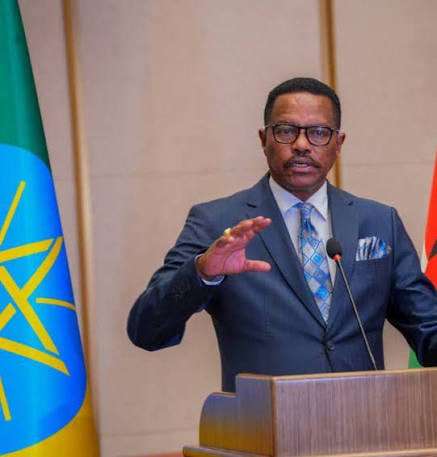
Ethiopia Today (Addis Ababa), September 27, 2029: The newly formed seven-group coalition arrayed against the Ethiopian federal government is structurally flawed, lacks domestic legitimacy, and functions as an instrument for regional powers, according to Ambassador General Bacha Debele.
In an interview with Horn Review, General Bacha outlined the military and political dynamics shaping Northern Ethiopia and Eritrea, arguing that the alliance for survival, locally known as Tsmdo, is unsustainable and driven by external strategic agendas originating in Cairo and Asmara rather than the domestic interests of its member groups.
The coalition brings together distinct political and armed factions, including elements of the Tigray People’s Liberation Front (TPLF), Fano, and the Oromo Liberation Army (OLA).
According to General Bacha, the alliance lacks the essential components of a viable military or political bloc, a unified command structure, a shared political program, and a coherent end-state.
“These groups have emerged from fundamentally different political circumstances, pursue divergent interests, and operate according to different calculations,” General Bacha stated. “An alliance constructed on such contradictions may generate temporary pressure, but it cannot translate that pressure into a sustainable strategic outcome.”
He noted that the TPLF’s political legitimacy has been severely eroded following the 2020–2022 conflict, while groups like Fano and the OLA have failed to articulate an inclusive, national platform.
General Bacha asserted that the strategic direction of the coalition originates outside Ethiopia’s borders, pointing specifically to Eritrean President Isaias Afwerki and Egyptian regional calculations.
According to General Bacha, the coalition represents President Isaias’s latest attempt to exploit Ethiopia’s internal vulnerabilities to preserve his regime. However, he argued that the ultimate strategic focal point of the enterprise is Cairo, which seeks to constrain Ethiopia’s regional influence across the Nile Basin, the Red Sea, and the Horn of Africa.
“The foundation of Tsimdo, or the seven-group alliance, lies neither in Mekelle nor in Asmara. In my assessment, its strategic direction comes from Cairo,” General Bacha said, warning that Ethiopian internal grievances are being instrumentalized by external actors whose goals do not align with the local populations represented by these groups.
Addressing the internal situation in Tigray, General Bacha criticized the senior leadership of the TPLF, naming figures such as Debretsion Gebremichael, Fetlework, Getachew Assefa, Haileselassie Girmay, and Birhane Negash (Woldemedhen).
He highlighted a growing rift within the Tigrayan security establishment, noting that several experienced military and intelligence officers have recently been dismissed, sidelined, or detained. According to General Bacha, these officers were targeted for opposing a renewed military confrontation with the federal government and rejecting a strategic alignment with the Eritrean regime.
General Bacha stressed that Tigrayan youth, having suffered significant casualties in recent years, should not be sacrificed for the political calculations of an unaligned leadership or placed at the disposal of an external power. He reiterated that the future of Tigray remains within the Ethiopian federation.
Regarding Ethiopia’s military posture, General Bacha explained that the federal government has deliberately exercised strategic restraint in the face of border incursions and external provocations. Responding on Eritrea’s terms, he noted, would have served Asmara’s goal of manufacturing a broader regional crisis.
However, he issued a warning regarding the limits of that restraint, stating that if open confrontation persists, the operational theater may not remain confined to Ethiopian territory.
“Sovereignty is not a principle that can be applied selectively,” General Bacha remarked. “If Eritrea chooses escalation, it must also be prepared to bear the consequences of that decision.”
He concluded that Eritrea requires a fundamental recalibration of its foreign policy moving away from proxy conflicts and perpetual confrontation toward transactional diplomacy based on mutual respect for national sovereignty.