By: Our Staff Reporter
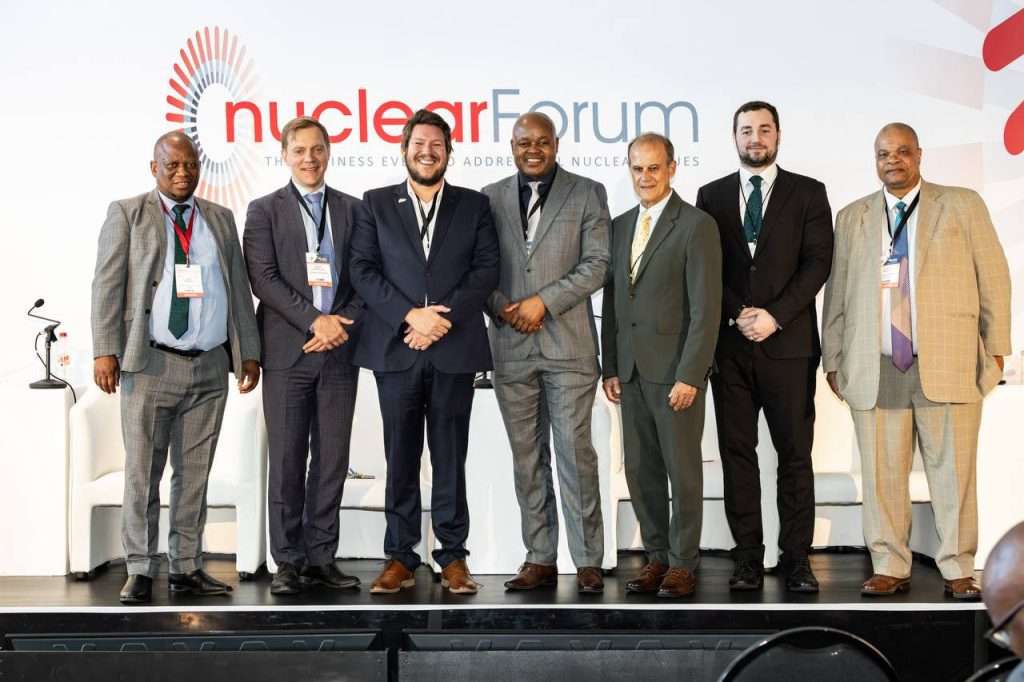
Ethiopia Today (Addis Ababa) March 9,2026: Rosatom representatives took part in the Nuclear Forum at Africa Energy Indaba in Cape Town, highlighting infrastructure development, human capital, and the localisation of nuclear projects across the African continent.
The Nuclear Forum brought together nuclear industry representatives from African countries, as well as leading global nuclear companies and organisations. Participants discussed key trends in nuclear technology and shared practical experience in delivering major international projects.
Ryan Collyer, CEO of Rosatom Central and Southern Africa, presented the potential of floating
power unit (FPU) technology. Rosatom’s floating nuclear power plant (FNPP) Akademik
Lomonosov supplies electricity to a remote Arctic region of Russia and remains the world’s only
operating floating nuclear power plant.
“For energy-deficient regions, floating power units offer an optimal solution: mobility,
scalability, and sufficient electricity generation, while minimising the use of adjacent land. In
2024, the company announced the development of FPU technology for tropical climates, which
will meet the specific needs of the African continent. Rosatom not only offers a ready-made
technology but also arranges training for local personnel to ensure the operation of the reactors,”
explained Ryan Collyer.
The forum also focused on the construction of largescale nuclear power plants, including Egypt’s
El Dabaa NPP, the first nuclear power station in Africa being built by Rosatom. “Localisation is
an integral component of Rosatom’s nuclear new-build strategy. At El Dabaa Nuclear Power
Plant, we are systematically increasing the involvement of Egyptian industry, prioritising
capacity building, and ensuring the structured transfer of technology and expertise to create
sustainable value beyond power generation.
As a global developer of nuclear power plants, Rosatom is committed to responsible project implementation, strengthening local supply chains, advancing national competencies, and contributing to long-term socio-economic development in countries where we operate” emphasised Director of Rosatom Country Office in Egypt Murad Aslanov.
Participants underlined that nuclear power has a strategic role to play for African nations. In the
context of power capacity deficits and the transition to lowcarbon energy sources, nuclear
technologies offer proven and safe solutions capable of supplying reliable electricity for decades.
This, they noted, can underpin longterm energy security, industrial growth, and sustainable
development across the continent.
The 15th Nuclear Forum at Africa Energy Indaba is a dedicated platform for scrutinising global
nuclear trends, examining the possibility of small modular reactors’ (SMRs) deployment,
addressing regulatory, human capital and other challenges unique to African context, exploring
the role of nuclear energy in terms of economic development and decarbonisation across Africa
and demonstrating investment opportunities suited to African markets.
The floating nuclear power plant (FNPP), based in Pevek in the Chukotka Autonomous Okrug, is
the only operational floating NPP with low capacity and the northernmost nuclear power plant in
the world. One of its main tasks in the region is supplying energy for the large-scale mining
operations at the main deposits in the Baimskaya ore area. One of the consumers of the energy
generated by the FNPP is Peschanka, the largest deposit being also the basis for the promising
Baimskoye mining and processing plant.
The total energy that the Akademik Lomonosov power unit generates for the Pevek coastal network without thermal energy onshore consumption is 70 MW, and approximately 44 MW in the maximum thermal power mode.
El-Dabaa NPP is the first NPP in Egypt. It is being built in the city of El-Dabaa, in the Matruh
province on the Mediterranean coast, approximately 300 km. north-west from Cairo. The NPP
consists of four 1200 MW power units equipped with Russian VVER-1200 pressurised water
reactors of the latest third generation; these reactors are state-of-the art technologies that have
been successfully operated at reference NPPs.