By: Dawit Astatike
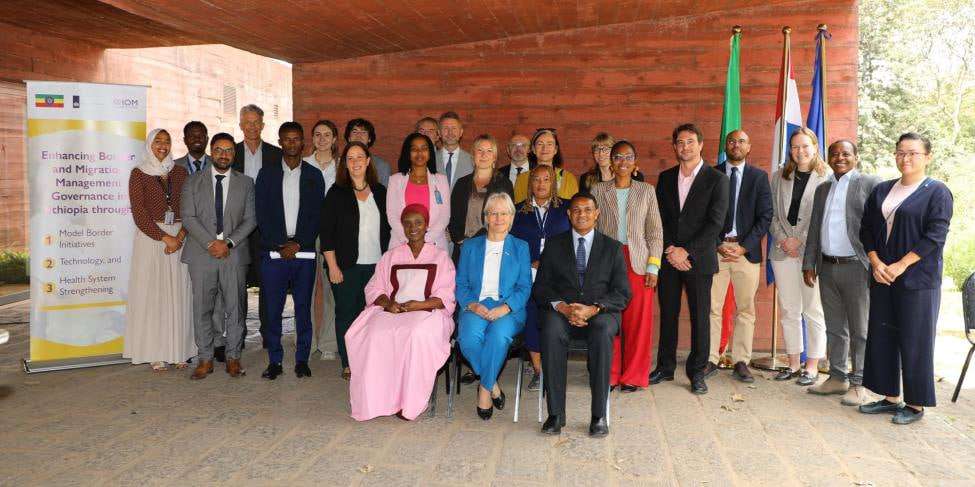
Ethiopia Today (Addis Ababa) march12, 2026: The International Organization for Migration (IOM), in partnership with the Government of Ethiopia and with the support of the Kingdom of the Netherlands, launched the project “Enhancing Border and Migration Management Governance in Ethiopia through Model Border Initiatives, Technology, and Health System Strengthening”. With a budget of EUR 5 million, this new initiative aims to strengthen border and migration governance by modernizing border management approaches, enhancing technology systems, and improving public health preparedness at points of entry.
The project launch event brought together senior representatives from Ethiopian government institutions, diplomatic missions, development partners and international organizations.
Ethiopia occupies a pivotal position in regional migration dynamics in the East and Horn of Africa, serving as a country of origin, transit and destination. Located along major migration corridors, including the Eastern and the Southern Routes, the country experiences significant cross-border mobility every year. Border areas are also key gateways for regional trade and mobility. The Ethiopia–Djibouti corridor, including the Dewele border crossing, is one of the most important entry and exit points for people and goods in the country.
However, infrastructure gaps, evolving transnational security risks, digitalization needs, and public health vulnerabilities continue to challenge effective border governance. In response, the Government of Ethiopia has committed to a comprehensive modernization agenda aimed at establishing modern land border control points, strengthening migration management systems and enhancing institutional coordination. The newly launched project will support this national effort by taking a comprehensive approach built around three mutually reinforcing pillars.
The first pillar focuses on transforming Dewele into a Model Border Control Point, demonstrating a modern, integrated and protection-sensitive land border management system. The initiative will support infrastructure upgrades aligned with international standards, strengthen the capacity of border officials to address migrant smuggling and trafficking, and operationalize protection-sensitive screening and referral mechanisms in coordination with the nearby IOM-supported Migrant Response Centre. The project will also engage border communities to strengthen awareness on safe migration.
The second pillar will support Ethiopia in establishing the legal and institutional foundations for the country’s first Advance Passenger Information (API) system, enabling authorities to strengthen risk analysis and border security through improved data management and interagency coordination.
The third pillar focuses on strengthening Health, Border and Mobility Management capacities to better manage public health risks at points of entry. Activities will enhance cross-border health surveillance, strengthen collaboration between health and border authorities, and improve preparedness and response mechanisms during public health emergencies to ensure the continuity of safe cross-border movement.
“The Ethiopian Public Health Institute (EPHI) is mandated to oversee border health management, including prevention and case management, particularly at key entry points such as Dewele,” said Dr. Mesay Hailu, the Director General of the EPHI during the launch event. “We remain fully committed to strengthening preparedness and response to public health emergencies, supporting evidence-based policy decision-making, and enhancing collaboration to advance national and international health security,” he added.
“Today’s project represents a new chapter in the migration partnership between the Netherlands and Ethiopia. It recognizes Ethiopia’s position in the East and Horn of Africa as a country of origin, transit, and destination for complex and dynamic migration flows, as well as the challenges this entails in managing mobility, trade flows, and security risks along a border that spans more than 5,000 kilometers,” said H.E. Christine Pirenne, Ambassador of the Kingdom of the Netherlands to Ethiopia. “Projects like this, centered on mutual respect, recognition of respective government priorities, and a commitment to a whole-of-government approach, provide a model to be emulated,” she added.
The project aligns with Strategic Objective 3 of IOM Ethiopia’s Country Strategy (2025–2029) and builds on ongoing efforts to modernize migration management systems, including the expansion of the Migration Information and Data Analysis System (MIDAS) to additional ports of entry across Ethiopia.
“Effective border governance today requires more than infrastructure. It requires strong institutions, reliable data systems, coordinated responses and protection-sensitive approaches that safeguard people on the move while facilitating safe mobility and trade,” said Abibatou Wane-Fall, IOM Chief of Mission to Ethiopia