
By: Our Staff Reporter
Ethiopia Today (Addis Ababa) May 22, 2026; In a major boost to East Africa’s extractive sector, Kolkata-headquartered steel and mining giant Rashmi Group has signed a landmark Memorandum of Understanding (MoU) to inject approximately $300 million into Ethiopia’s gold mining and mineral processing industries.
The agreement was finalized at the high-profile “Invest in Ethiopia – High-Level Business Forum 2026” held in Addis Ababa. As part of the deal, the $575-million conglomerate has formally filed applications for gold mining licenses in Ethiopia’s western regions of Gambela and Benishangul-Gumuz.
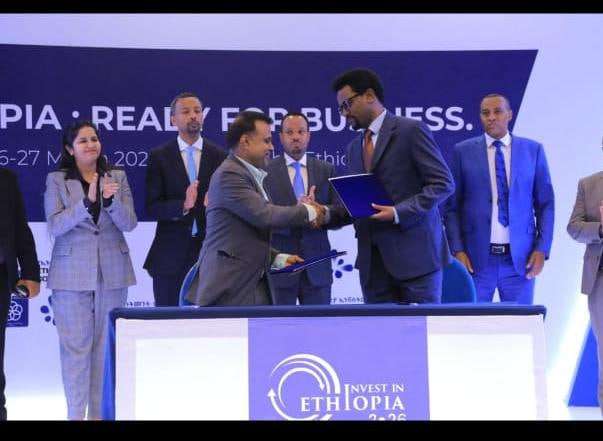
The MoU was signed by Sunil Kumar Patwari, Chief Executive of Rashmi Group, and Zeleke Temesgen, in the presence of Ethiopia’s Minister of Finance Ahmed Shide and Brook Taye.
Unlocking the Arabian-Nubian Shield
The proposed $300 million investment will fund extensive gold exploration, mine development, and the construction of aggregate production and mineral processing facilities. These facilities are designed to supply raw materials directly to Ethiopia’s rapidly expanding infrastructure and construction sectors.
The targeted regions, Gambela and Benishangul-Gumuz, sit directly on Ethiopia’s western greenstone belt. This terrain forms a critical part of the Arabian-Nubian Shield—a massive Precambrian rock formation stretching across nine countries from the Nile basin to the Saudi Arabian highlands, widely regarded as one of Africa’s richest gold-bearing structures.
The Asosa zone within Benishangul-Gumuz is highly prized for its gold deposits associated with shear-zone-controlled quartz veins. While the area has historically supported artisanal miners, Ethiopia’s formal gold sector has lagged. National gold output plummeted from 12 tonnes in 2013 to under four tonnes in 2018, seeing only a minor, pandemic-era recovery via small-scale artisanal mining. Rashmi Group’s entry aims to transition the region into large-scale, commercialized production.
A Backdrop of Economic Reform and Growth
The investment aligns perfectly with Addis Ababa’s “Home-Grown Economic Reform Agenda 2.0.” This market-opening initiative actively courts foreign direct investment (FDI), private sector participation, and export diversification in areas previously monopolized by state-owned enterprises.
Furthermore, economic ties between New Delhi and Addis Ababa are at an all-time high following Prime Minister Narendra Modi’s historic bilateral visit to Ethiopia in December 2025. During the visit, bilateral ties were elevated to a “Strategic Partnership,” resulting in eight comprehensive agreements spanning digital infrastructure, customs cooperation, defense training, and artificial intelligence.
“Ethiopia’s geostrategic location, its economic reforms, and the elevation of India–Ethiopia relations to a strategic partnership all provide additional confidence for Indian investors. According to IMF forecasts for 2026, Ethiopia is expected to grow at 9.2%, making it one of the fastest-growing economies in the world.” — Anil Kumar Rai, Indian Ambassador to Ethiopia
Redefining Africa’s Gold Value Chain
While Africa accounts for roughly one-quarter of global gold production—outputting nearly 800 tonnes annually—the continent suffers from a severe lack of refining and processing infrastructure outside of South Africa. Ethiopia has made it a policy priority to change this dynamic by retaining more value domestically.
For Rashmi Group, this move is part of a grander continental strategy.
“Through technology transfer, infrastructure development, mineral processing, and local employment generation, we aim to contribute to Ethiopia’s economic transformation,” said Sunil Kumar Patwari, CEO of Rashmi Group. He added that the $300 million outlay reflects deep confidence in the local regulatory environment, viewing Ethiopia as a strategic launchpad for wider corporate engagement across the African continent.
With over 615 Indian companies already operating in Ethiopia and two-way trade reaching $2.3 billion in the 2024–25 fiscal year, Rashmi Group’s mega-investment marks the next major chapter in India-Africa economic cooperation.



