By: Our Staff Reporter
Ethiopia Today (Addis Ababa) April 27, 2026: For 61-year-old Mebrhatu Gebreegziabher, a veteran who served his country for 25 years, the simple act of a medical check-up used to be a routine part of life. But after years of conflict in northern Ethiopia’s Tigray region, the stability he once knew vanished, taking healthcare with it. For three years, the “life-saving” vaccines and screenings he needed were out of reach until a mobile health team arrived at his doorstep in the remote village of Agebe.
Mebrhatu’s story is a cornerstone of the Saving Lives and Livelihoods (SLL) program, a massive health intervention by the Africa CDC and Amref Health Africa, funded by the Mastercard Foundation. Now in its second phase, the program is successfully piercing through the barriers of geography and conflict to reach those that the traditional healthcare system left behind.
The Battle Against “Zero-Dose” Status
Ethiopia faces a staggering public health challenge: an estimated 3.9 million “zero-dose” children—infants and toddlers who have never received a single routine vaccination. In regions like Tigray, the conflict didn’t just pause services; it created a generation of unprotected children.
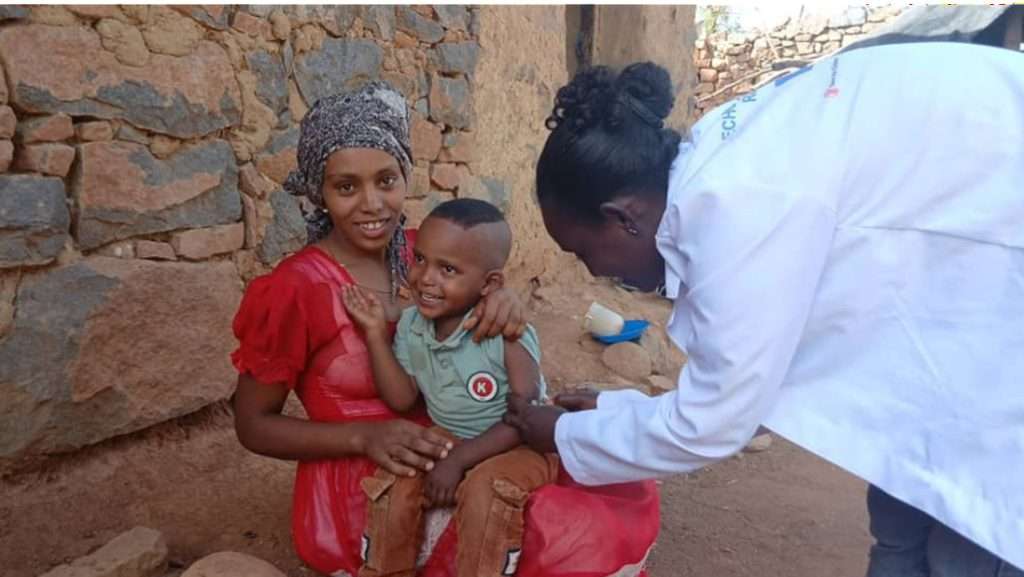
Take three-year-old Philmon Haylome. Born during the height of the unrest, Philmon missed every milestone of the routine immunization schedule. His mother, Kisanet Teklay, lived in constant fear, believing her son had “aged out” of eligibility for help.
“I thought once a child got older, health workers wouldn’t vaccinate him anymore,” she recalled. Through the SLL project’s integrated digital headcount and mobile campaign, Philmon was finally identified and vaccinated against seven deadly diseases, including polio and measles. He is one of more than 3,000 zero-dose children recently rescued from medical invisibility in these remote corridors.
Beyond the Needle: Integrated Care for All Ages
What makes the SLL program unique is its “life-course approach.” It doesn’t just focus on children; it looks at the community as a whole. For elders like Mebrhatu, the arrival of the health team meant more than a COVID-19 shot; it meant his first screening for hypertension and diabetes in years.
“I am going to champion awareness in my community to ensure my people live healthily and long,” Mebrhatu declared, committing to regular screenings every three months. By bundling COVID-19 vaccinations with chronic disease (NCD) screenings, the program maximizes every visit to these isolated areas.
Overcoming the “Bajaj Barrier”
In the Afar region, the obstacles aren’t just remnants of conflict—they are financial and physical. For Abdu Mohammed, a 49-year-old father in the Mille district, a single trip to a health facility required hiring a Bajaj (three-wheeled taxi) for 350 ETB—a price his family simply could not pay.
“The journey is difficult: rocky roads, scorching heat, and long travel times,” Abdu explained. “I never imagined healthcare would one day come directly to our home.”
The SLL project’s mobile teams have now reached over 700,000 households, often vaccinating upwards of 30,000 people in a single day. For Abdu and his four-year-old son, the arrival of these teams meant their first-ever vaccinations, delivered without the burden of a costly or dangerous journey.
A Global Model for Equity
As Ethiopia works toward its 2030 health goals, the SLL program serves as a blueprint for reaching the “unreachable.” By combining digital tracking with door-to-door physical outreach, the Africa CDC and its partners are narrowing a dangerous immunity gap.
From the veterans of Tigray to the nomadic families of Afar, the message is clear. Geography and history should not be a death sentence. In the remote corners of Ethiopia, the tale is no longer one of lost chances but of a future where every child and elder is counted, protected, and given a chance to thrive.